
When did maternal autonomy become a product? Thoughts on cosleeping, free birth, and a $13 million empire
An Instagram post, a Guardian exposé and the commodification of maternal rage

A note on terminology:
Throughout this piece, when I refer to “free birth” or “wild birth,” I’m not talking about home births with qualified midwives in attendance. I’m not talking about women who’ve hired qualified doulas and have backup plans. Free birth means giving birth without any medical professionals present at all - no midwife, no doctor, nobody trained to recognise or respond to complications. Wild pregnancy - the term often used alongside free birth - takes it even further with no prenatal care whatsoever. No scans, no midwifery appointments, no monitoring.
I first learned about what I now understand was free birthing/wild birthing about 7 years ago. I had heard about a colleague’s partner who was choosing to go through the entirety of her pregnancy without any scans or midwifery appointments at all.
I was childless at the time and what I’d consider a babe myself at only 25. Knowing nothing about what it felt like to carry a child I wondered if I was ill-placed to feel so aghast by this concept. Maybe I just didn’t get it yet.
Still, I couldn’t wrap my head around it.
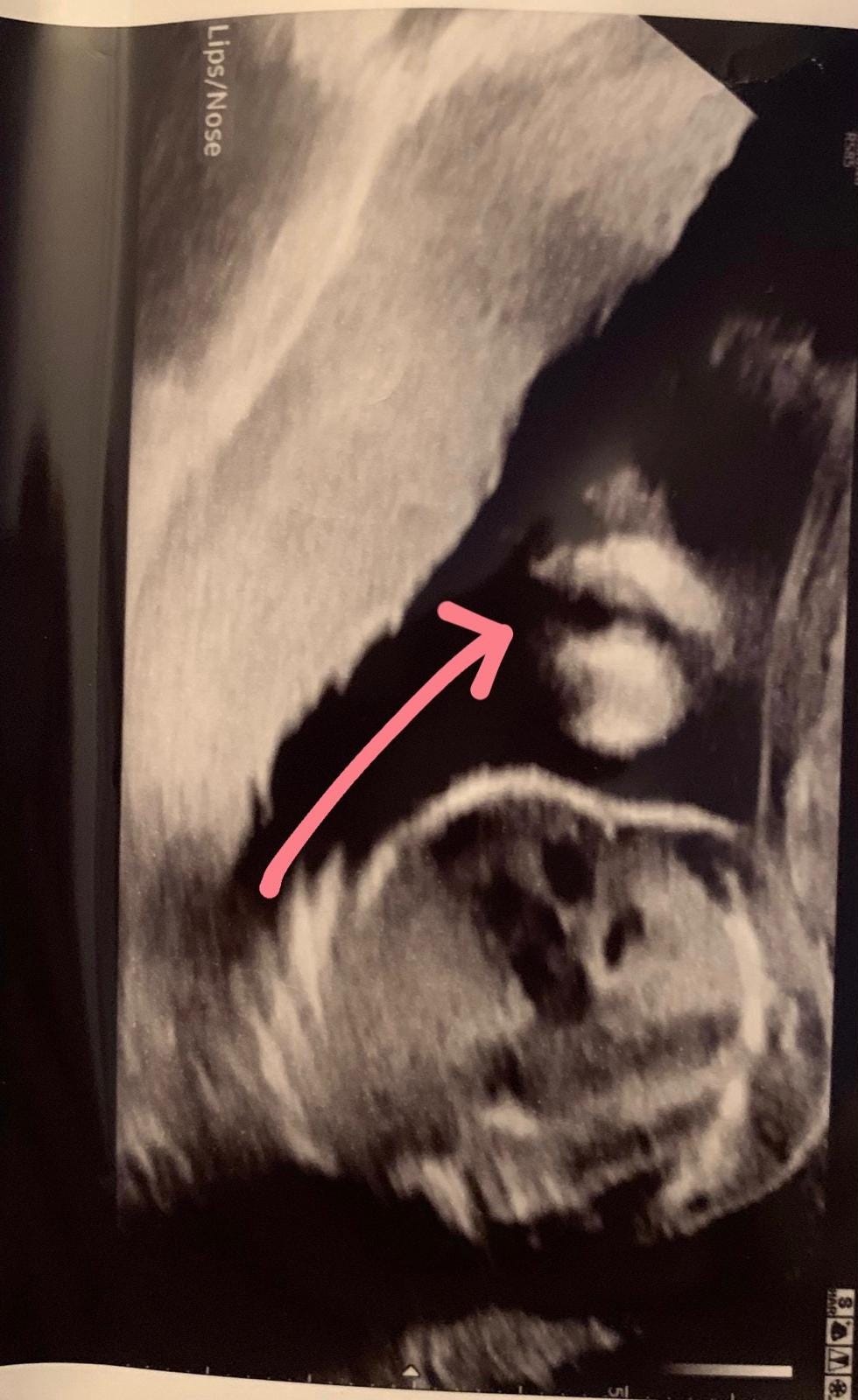
How could you get through a pregnancy without scans now they existed? Not just for the practical reassurance - knowing your baby is growing properly, that everything is developing as it should, that you were both okay - but for the joy of it. The chance to see them on those grainy black and white images that you’d stare at for hours, trying to make out a profile, a hand, a foot - some proof that there was actually a whole person in there - that you hadn’t dreamed the whole thing up.
Flash forward 5 years and I vividly remember seeing my sons lips in a scan picture, all smooshed. It’s one of my favourites. I’d marvel at it over and over and over again - before I knew his face like it was my own. When he was finally in my arms that scan picture came out again, so I could compare. There they were. Those perfect, now milk soaked, lips. Lips that I’d grown from scratch. What a wonder.
Free birth/wild birth wasn’t something I thought about again after that day 7 or so years ago.
Until the second time it entered my orbit. This time on Instagram, a few months ago, now a mother myself.
It was a carousel. A mother I didn’t follow, all flowing linen and bare feet in long grass, had put together a post listing all the ways she was rejecting modern parenting norms. In it were things like extended breastfeeding, responsive parenting, cosleeping and then, you guessed it - free birthing.
I did that thing where you sort of just sit with it for a moment. I love seeing other people talking about cosleeping online. But seeing it next to free birthing in the way she was talking about free birthing made me feel weird. A bit like when someone awful likes something you like and now you can’t like that thing.
It’s no secret that many people view free birthing as inherently dangerous. And to be completely transparent I may well be one of them. I sort of get the desire, but am far too fearful to do it myself. That said, I understand that birth choices are deeply personal and I’m not here to judge anyone else’s.
So if I wasn’t just being a negative nancy judgemental bitch, why did I feel weird about the post?
When I unpick why I felt uncomfortable, I think it was concern over how people could perceive these things when put together in this way. People seeing that carousel and understanding it all as the same thing. Cosleeping, freebirth, responsive parenting - all just part of the same package. All the same rejection of mainstream advice - equivalent acts of maternal defiance, both a means of “returning to our natural instincts.”
Anyone that’s been here for a while can attest to the fact that I write about cosleeping a lot. And anyone in my real life can attest to the fact that I sing its praises there too.
I’ve written hundreds (no, thousands!) of words pushing back against the narratives that persist against cosleeping as a practice, arguing that the fear mongering around bed sharing is overblown, that humans have slept with their babies since the dawn of time, and that we need to trust mothers and their instincts rather than isolating them with rules based on flawed studies and moral panic.
And when I looked at the Instagram post, I saw what could be confused with my language, sitting next to a practice being described in a way that rung alarm bells in my head. And I worried that seeing them together like that would make it harder to have any sensible conversation about cosleeping. That when I push back against the fear-mongering around bedsharing, people could continue to easily write it off as “just another unsafe practice by some hippie earth mother”. That everything I try to say would get dismissed because it all looks like the same thing when it’s packaged together in flowing linen.
I had feelings but I wasn’t sure what to do with them.
Then the Guardian published a year-long investigation into the Free Birth Society, making this week the third time free birth has entered my radar. It makes for very sombre reading.
Reading it did more than make me feel a bit uncomfy, so it’s something I want to talk about.

According to The Guardian investigation, The Free Birth Society (FBS), has generated over $13 million selling courses and community memberships to women who are taught that birth cannot fail them (and if it does you simply take “radical responsibility” for it). They promote both free birth and wild birth. They’re explicitly anti-ultrasound (falsely claiming it harms babies), they downplay serious medical conditions, and they teach that most birth complications are just “variations of normal.”
At least 18 babies are dead. Others are severely disabled. Their mothers paid $299 for membership, $399 for video courses, up to $6,000 for “midwifery” training from women with no medical qualifications, and then - after their babies died - another $350 for “trauma debriefs” where they were told that death isn’t necessarily a bad outcome.
It feels less like supporting women who want to avoid unnecessary medical intervention, and more about rejecting medical knowledge entirely (with a hefty fee).
I’m not going to get into all the specifics here - if you’re interested, I’d urge you to read the Guardian article. It’s a long one but definitely worth your time.
And I’m aware - very aware - of how media tends to sensationalise anything that sits outside what’s considered the ‘done thing’, especially when it comes to mothers and their choices. I know how quickly things that challenge the mainstream get painted as dangerous or extreme, often unfairly. But it seems in this case the condemnation of FBS is warranted.
And reading the words of condemnation brought me back to that Instagram post - the one with cosleeping and free birth packaged up together. And I know it might sound like a reach - talking about cosleeping in the same breath as an investigation into an organisation that describes newborn resuscitation as “sabotage”, that told a mother her premature baby’s shallow breathing was “totally normal”, and that teaches women to see seeking medical help as ideological failure - but let me explain.
Because I think it’s part of a bigger thing…
“It’s not safe, babies die.”
“You’re putting your ideology above your child’s safety.”
“The guidelines exist for a reason.”
“You’re being selfish and reckless.”
These are all things I’ve heard about cosleeping.
“It’s not safe, babies die.”
“You’re putting your ideology above your child’s safety.”
“Medical guidelines exist for a reason.”
“You’re being selfish and reckless.”
These are all things many say about free birth/wild birth.
So I have to ask - if I personally think those arguments are rubbish when they’re applied to cosleeping - if I think they’re a patronising, pearl-clutching overreach that treats women like idiots who are inherently dangerous to their children - then how would I argue they’re valid when applied to free birth without sounding like a complete hypocrite?
How do you say one is evidence-based maternal autonomy and the other is dangerous ideology without sounding like you’re just picking and choosing which rules to follow based on what suits you? How do women end up making the journey from one to the other?
When I was pregnant, I read up on hypnobirthing (I’ve written about this here). Not because I’m anti-medical - I’m absolutely not - far from it actually. I had every scan going, I went to all my midwife appointments and I gave birth in hospital. I’d have preferred the midwife-led unit on site but this was closed - no surprise! I looked into other options, found another midwife-led unit that looked great - a home away from home if you will. But it would have meant going to a hospital over half an hour away if I needed emergency help. That felt too far. So local hospital birth it was.
My choices, like so many women’s, were already limited before I’d even started.
So I did hypnobirthing because I wanted to feel informed and in control. I wanted to understand what was happening to my body. I didn’t want decisions made for me that I didn’t understand.
And for the most part, it was fine. I still appreciate the feeling of control it gave me in the lead up (regardless of the fact I ripped my birth plan up and swore that I didn’t fucking care anymore barely 10 minutes after arriving at the hospital with my precipitous labour1). But there were also parts of the community that had an undertone of... dare I say it… not quite conspiracy, but close.
“The medical establishment doesn’t want you to know this. Doctors are trained to intervene unnecessarily. Hospitals create the emergencies they then have to solve. Your body knows what to do, if only they’d leave you alone.”
And of course, there is truth to this.
The medical system often IS patronising, paternalistic, and overly interventionist, especially to women, and especially to women of colour.
And in the UK specifically, maternity services are failing women. According to the Care Quality Commission, safety levels in almost two thirds of English hospitals’ maternity services are either inadequate or require improvement. This is unacceptable.
In 2024, a birth trauma inquiry received submissions from more than 1,300 women who had experienced traumatic births in the NHS. Home birth services, which used to provide an alternative, were largely closed during the pandemic and have never recovered.
Dr Claire Feeley, a senior lecturer in midwifery at King’s College London, has said that women are sometimes choosing freebirth as a “back-up plan” because they don’t want to give birth in hospital - and in areas with strong home birth teams, there’s hardly any freebirthing at all.
“Although freebirthing is a first choice for a few, for most it seems to be a ‘least worst’ option”
- Prof Soo Downe, a senior British midwife at the University of Lancashire.
So for many, it appears that freebirthing is not necessarily a first choice, but the option that feels safest when the system has already failed them.
These are legitimate grievances. Real problems that deserve real anger.
But some could argue that this is the crack in the door.
You start with legitimate criticism of a system that genuinely does fail women, and before long you’re being told that ALL medical intervention is suspect, that trusting doctors is naive and that your body simply cannot fail you.
It’s not hard to see how all of this happens. The women who end up in communities like the FBS aren’t stupid or gullible, it’s just that the pathway is so carefully constructed that each step feels reasonable.
You’re pregnant. You’re doing research, trying to be informed. You discover that medical professionals sometimes get it wrong with women’s bodies - dramatically, harmfully wrong. You feel angry about that. Rightfully so.
You find communities that share that anger. They talk about obstetric violence, which is real. They talk about trusting your body, which sounds empowering. They show you images of women who look peaceful and powerful, holding babies they birthed exactly how they wanted to.
And then they tell you “see? This is what’s possible when you stop letting fear control you. When you stop letting doctors interfere.”
Somewhere along the road, “question unnecessary intervention” becomes “question all intervention.” “Trust your instincts” becomes “your instincts are infallible.” “Your body is capable of amazing things” becomes “your body cannot fail.”
The language is almost identical at each stage. Which is why it’s so hard to point at the moment where reasonable scepticism tips into dangerous ideology.
But what does any of this have to do with cosleeping? Why am I writing about the Free Birth Society when what started me off was an Instagram carousel?
When I saw cosleeping lumped in with free birth in the way this mother was talking about it it made me uncomfortable. It made me uncomfortable because when they’re both packaged as “returning to our natural instincts,” they’re being presented as equivalent acts.
When someone lists them side by side in flowing linen aesthetics, they’re suggesting we’re part of the same movement. That we’re both rejecting guidelines in favour of some romantic idea about how humans used to live.
So where do we draw the line?
How do I argue that cosleeping is brilliant actually thank you very much but free birth is dangerous without sounding like I’m just picking and choosing willy-nilly? What’s the difference between evidence-based maternal autonomy and ideology masquerading as empowerment?
I think the difference comes down to this - birth is unpredictable.
Even writing that makes me feel as though I’m breaking some sacred sisterhood bond. Because it’s this idea that often winds up with women experiencing medical interventions that they don’t need.
I am not saying that birth is unpredictable in the sense that it is this terrifying medical emergency that will definitely kill you unless you’re strapped to monitors in a hospital following every instruction. That’s not what I mean, or what I believe.
Most births, for most healthy women, go absolutely fine. Low-risk pregnancies are low-risk for a reason.
But even in healthy women, even in low-risk pregnancies, things can go wrong unpredictably. Bad things can happen to anyone, without warning, even when everything has been textbook up to that point.
There’s a reason maternal and infant mortality was so high before modern medicine. There’s a reason women and babies still die in places without medical care. There are old sayings about birth being the closest women come to death - not to be dramatic or fear-mongering, but because historically, it was true.
Birth can go wrong. Not always. Not even usually. But it can, and when it does, minutes matter.
Sleep isn’t like that.
Humans have been sleeping with their babies across cultures, across continents, for all of human history without issue. The risks associated with bedsharing in Western contexts come from specific, identifiable factors - smoking, drinking, medications, sleeping on unsafe surfaces like sofas to name a few. These are all factors you can control. Remove those factors and you’re left with something humans have done safely for a really really really long time.
When the Free Birth Society says “birth is safe, your body cannot fail you, complications are just variations of normal” - they’re asking women to deny reality about how unpredictable birth can be.
A woman choosing free birth could argue that she’s low-risk, healthy, and informed. She’s assessed her situation. She knows what to look out for.
And maybe she is low-risk. Maybe everything would go fine.
But what happens when it doesn’t? What happens when the baby gets stuck, when labour goes on for days, when something genuinely goes wrong in a way that no amount of “trusting your body” will fix?
The Free Birth Society teaches women to interpret those moments as tests, as “variations of normal”. They explicitly teach that having a backup plan means you don’t truly believe in birth. That doubt is weakness.
By contrast, FBS taught that even contemplating a back-up plan was a sign of moral failure, because the truly sovereign woman trusted birth. “You have to choose one world or the other,” Norris-Clark told followers in a video call. “And if you’re setting up a medical team in the room next door, you’re not getting the best of both worlds. You’re choosing the medical world.”
When I write about cosleeping I’m not telling people that having a firm mattress and not sleeping on sofas means you don’t truly trust sleep. I don’t say taking your child to the doctor when they seem unwell is failure.
Free birth, the way FBS teaches it, requires ideological commitment. It requires you to override your instincts when they tell you something’s wrong. It requires you to see seeking help as betrayal.
That should be the line.
Not whether you’re following guidelines or breaking them, but whether the choice you’re making still allows you to respond to reality, or whether it requires you to deny reality to stay committed.
I can cosleep and still take my son to A&E if he seems unwell. Those things don’t contradict each other.
You can’t fully commit to free birth the way FBS teaches it and also be ready to transfer to hospital at the first sign of trouble. Within that framework, those things do contradict each other.
But to someone scrolling Instagram, looking at that carousel with the flowing linen and bare feet in grass and the caption about cosleeping and free birthing being part of the same parenting deal none of these distinctions are visible.
Cosleeping and free birth, both considered “returning to our natural instincts”, both presented as some sort of maternal reckoning against an overbearing establishment. Both using the same language about trust and empowerment and questioning guidelines.
From the outside, they could look the same. And maybe that’s not entirely accidental.
There’s real money in packaging maternal autonomy and selling it back to women. The Free Birth Society generated $13 million doing exactly that - taking women’s legitimate frustrations with a medical system that fails them, their genuine desire to protect their babies, their rightful anger at being patronised and dismissed, and turning it into courses, memberships, and “midwifery” training.
They’re profiting off the same impulses that make me want to cosleep with my son. The desire to do what’s best for him. To push back against fear-based nonsense. To trust myself. To reject a system that treats mothers like we’re inherently dangerous to our own children.
These are good instincts. Important ones.
But they’ve been co-opted, packaged and sold back to women in a way that’s dangerous.
Capitalism (and in this case the double-whammy of influencer culture) has a way of doing this. Of taking women’s genuine desires to live differently, to reject the systems that harm us, to protect our children from a world that often feels hostile to motherhood, by packaging it up into something you can buy. Something that comes with a community, an identity, a sense of belonging to something bigger than yourself.
For $299 you can join. For $399 you can learn. For $6,000 you can become one of the chosen ones who really gets it.
And if your baby dies? Well, that’s $350 more for someone to tell you it wasn’t necessarily a bad outcome.
The Free Birth Society isn’t unique in this. There’s a whole industry built on selling various versions of maternal empowerment back to mothers who are desperate to feel like they’re doing the right thing. Sometimes it’s harmless - overpriced organic baby food, expensive wooden toys, courses on gentle parenting. Sometimes it’s actively dangerous.
But it all uses the same language. It all taps into the same very real desire that mothers have to reject a paternalistic, capitalistic system that tells us we’re doing it wrong, that we need more products, more interventions, more experts to tell us how to raise our own children.
And that desire is valid. That anger is righteous.
But when it gets monetised, when it becomes an ideology you have to buy into, and when questioning that ideology means you’re not truly committed - questions need to be asked.
Going back to the Instagram post I’ve found myself pondering if the real problem isn’t the conflation itself, but what the conflation serves. When everything gets flattened into one aesthetic, one vibe, one marketable identity of the “natural mother” who trusts her instincts and rejects the establishment - it becomes very hard to distinguish between pushing back against actual harm and walking willingly into it.
It becomes very easy to sell women a sense of empowerment while actually putting them and their babies at risk.
And it makes it very difficult for someone like me to say “actually, the fear-mongering about cosleeping is rubbish” without sounding like I’m part of the same movement that tells women to ignore that their baby has been crowning for seventeen minutes.
I don’t have a neat conclusion here. I don’t know how to untangle the language of genuine maternal autonomy from the language of dangerous ideology when they can sometimes sound so similar. I don’t know how we push back against systems that genuinely fail mothers without the possibility of accidentally building a pathway toward rejecting all expertise entirely.
What I do know is that when I cosleep with my son, I’m not making an ideological statement. I’m not buying into a movement or trying to prove something about natural motherhood. I’m just trying to keep us both sane and rested while doing what humans have safely done forever.
What I also know is that the mothers who ended up in the Free Birth Society weren’t stupid. They were doing what they thought was right to protect their babies. They were responding to real failures in the medical system with real anger. They deserved better than to have that anger monetised and sold back to them as ideology that got their children killed.
And I hope - though I’m not particularly optimistic - that there’s some sort of accountability for the people who built a $13 million empire by doing exactly that. Who charged grieving mothers $350 to be told their baby’s death wasn’t necessarily a bad outcome. Who are still, even now, promoting the same dangerous practices that led to those deaths.
The Guardian investigation should hold a mirror up.
I hope it matters and I hope something changes.
But mostly I hope that mothers stop being sold empowerment packages that put their babies at risk. That the language of maternal autonomy stops being weaponised for profit and that we can find a way to push back against systems that fail us without walking straight into ideology that fails us even more catastrophically.
*Enjoyed this essay about capitalism commodifying maternal autonomy? You can fight capitalism by... giving me money. Or don’t pay and just subscribe for free. Either way, I’m just happy to have you here!

A rapid or short labour to delivery
I think another big difference is that cosleeping really has been practiced forever, all over the world, very safely - whereas free birth the way it's practiced now is quite unusual. Women have always traditionally had other experienced women around to help, and even hundreds of years ago midwives would call in surgeons if necessary. Refusing all help in childbirth is radical to say the least.
I co-slept, baby-wore and attachment parented. I sought to have natural births but didn’t manage either time — in the first birth largely because of a hostile nurse and in the second for legit medical circumstances (a 10-pound footling breech who laughed at multiple external versions).
You could say I have a strong skepticism about obstetrics.
But I never considered birthing alone. No woman should, and historically, few women did. Someone experienced at attending births was normally around, either a midwife or someone of that sort. We’ve never expected women to go it alone.